
Chris Mark — tactical operator

Chris Mark

Security Thought Leader, Enterprise Security & Risk Strategy Professional

Over 30 years of experience across cyber, physical, maritime, and operational domains.

Author of 10 books and numerous articles. Co-author of PCI DSS.

Practitioner

Force Recon Marine. Navy Officer. Over 30 years building security systems and processes across every domain — from combat zones to payment networks.

Author

Six books on security, risk, deterrence, and AI. Academic papers on Bayesian reasoning and compellence theory. The writing distills hard-won operational knowledge.

Advisor

Board-level counsel to enterprises on security strategy, risk governance, and threat assessment. Expert witness. Executive coach. No vendor affiliations.

Featured Book

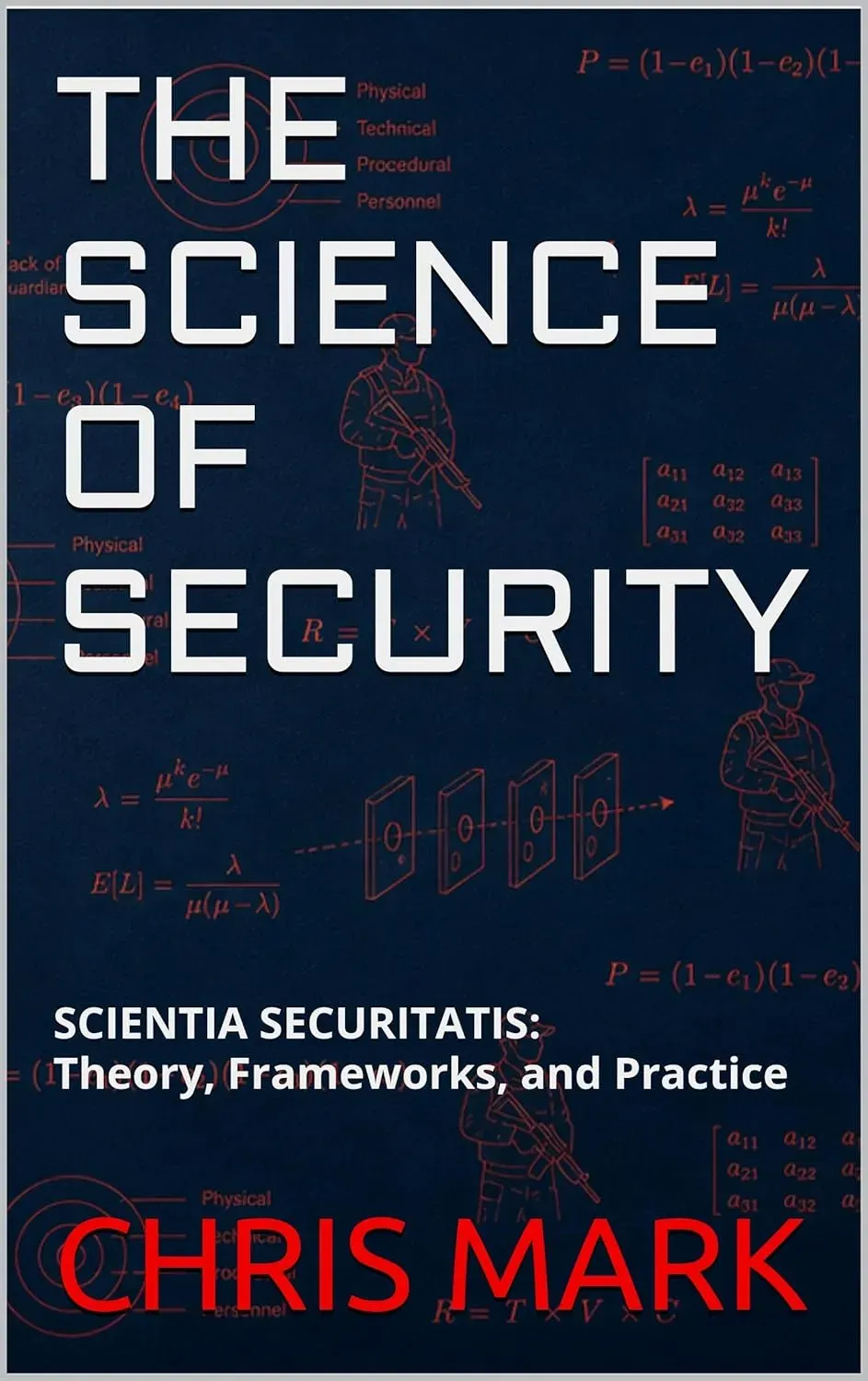
The Science of Security

The Science of Security book cover

Scientia Securitatis

A rigorous theoretical and practical framework for understanding security as a discipline — from mathematical formulations to real-world application. This book establishes the foundational principles that underpin every domain of security practice.

Written for practitioners and academics alike, it bridges the gap between security theory and operational reality.

Latest Writing

Recent Articles & Papers

SOF/Veterans·Academic Paper

A Marine Sniper Explains Recoil, Sound, and the Science and Benefits of a Silencer for the Modern Shooter

A quantitative examination of rifle recoil mechanics and suppressor thermodynamics grounded in conservation of momentum principles. Provides comparative ballistic data for .223 Remington, .308 Winchester, and .300 Winchester Magnum cartridges. Covers acoustic analysis of muzzle blast (140-175 dB) and suppressor operation via ideal gas law principles through sequential expansion chambers, achieving ~78% pressure reduction. Discusses performance metrics including 10-15% velocity standard deviation improvements and 60-80% reduction in cumulative hearing damage progression.

Read
Geopolitics·Academic Paper

Unrestricted Warfare: An Assessment of Chinese Intelligence Operations, Infrastructure Penetration, and Influence Campaigns Against the United States (2020-2025)

Comprehensive assessment of China's unrestricted warfare doctrine against the United States (2020-2025). Analyzes documented operations including Volt Typhoon's five-year penetration of critical infrastructure, Salt Typhoon's compromise of nine major U.S. telecom companies affecting over one million users, systematic academic infiltration through Confucius Institutes, IP theft costing ~$500 billion annually, congressional penetration operations, and state-level influence campaigns. Demonstrates how China employs cyber operations, political influence, academic exploitation, and infrastructure pre-positioning to achieve strategic objectives while avoiding direct military confrontation.

Read
Cybersecurity·Academic Paper

A Failed State of Security: An Analysis of Causality and Victim Blaming in Cybersecurity Incidents

Examines the cybersecurity industry's organized victim-blaming infrastructure that systematically excuses criminals while condemning breached organizations. Drawing from classical philosophy and contemporary causation theory, demonstrates that adversaries constitute the proximal cause of breaches — not organizational security decisions. Analyzes 2024–2025's unprecedented breach escalation including Change Healthcare (192.7M affected), PowerSchool (62.4M students), and Ticketmaster (560M records). Argues for fundamental reorientation toward adversary-focused deterrence, software vendor liability, and frameworks rewarding transparency.

Read
View all writing

Newsletter

Signal, Not Noise

Irregular dispatches on security, risk, AI, and deterrence theory. No spam. No sales funnels. Just the work.